Bond energy is the energy. For a double bond such as CO this number is _____because there isare_____ electron pairs shared between the two atoms.
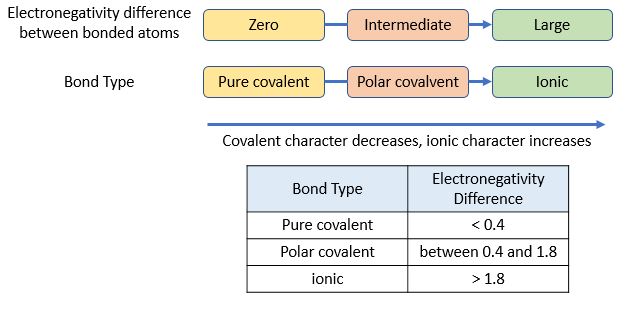
6 4 Polarity Of Molecules Introductory Chemistry
The more negative an elements electron affinity is.
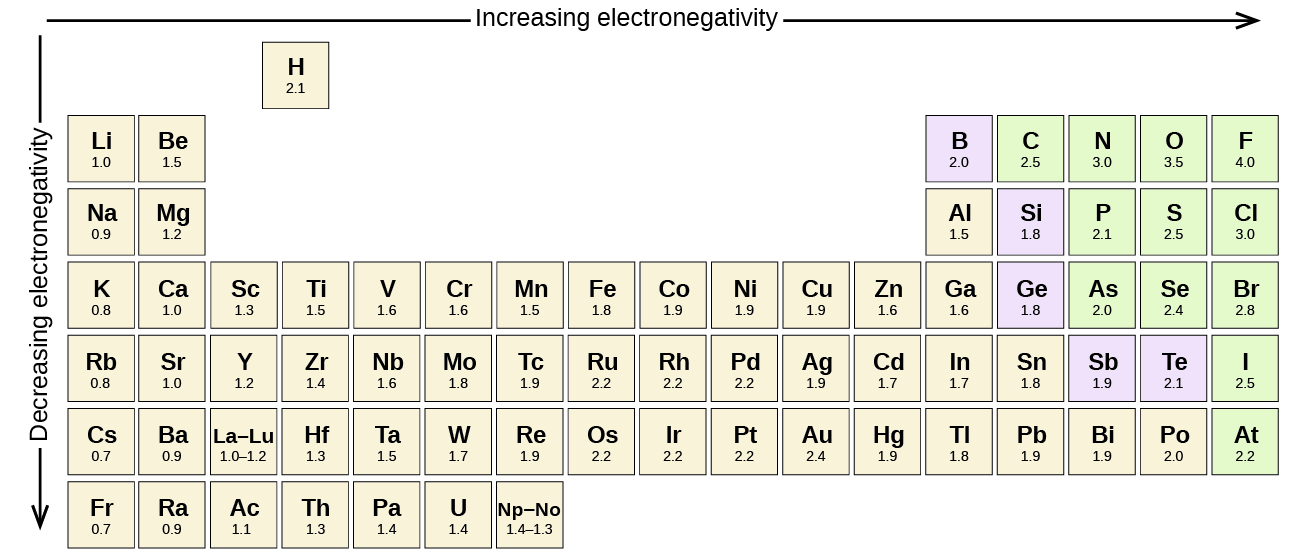
. However as we travel down the group from sodium to cesium the melting points of. Electronegativity symbolized as χ is the tendency for an atom of a given chemical element to attract shared electrons or electron density when forming a chemical bond. We can identify a potentially acidic H because it will be bonded to a more electronegative atom.
For example electronegativity of the N. Both O and F are more electronegative than C so the vectors point towards the O and F atoms in each bond. Remember me on this computer.
It really has been that long. Preface The Essentials of Physical Chemistry has been written for BSc students. A central C atom is single bonded to.
For a device designer as the precise material does not matter it is convenient to define an electrical thickness of a new oxide in terms of its equivalent silicon dioxide thickness or equivalent oxide thickness EOT 2 t ox EOT 39 K t HiK Here 39 is the static dielectric constant of SiO 2The objective is to develop high K oxides to allow scaling to continue to very. It has been used by more than 2 million students. Which of the following statements correctly describe bond energy.
The result is that the electron density in the bond will lie mainly with the more electronegative atom eg. Because a hydrogen atom is so small these dipoles can also approach one another more closely than. The melting point of lithium halides is lower than that of sodium halides for the identical halide ion.
This book is ideal for who want to use a strong molecular-orbital approach to explain structure and reactivity in inorganic chemistry. This is described in terms of the metal halides lattice energy. The electronegativity difference between C and F is slightly greater than the electronegativity difference between O and C so the net vector is between the two F atoms.
Electronegativity is a measurement of the energy released when an atom forms a negative ion. O N or ClThe outcome is that for example an HO bond will be weakened require less energy to break. Log in with Facebook Log in with Google.
Bond energy is equal in magnitude to the energy released when a bond is formed. An atoms electronegativity is affected by both its atomic number and the distance at which its valence electrons reside from the charged nucleus. It has been national bestseller for more than 65 years.
Electronegativity is a measu re of how strongly atoms attract bonding electron s. Oc o Figure 52 Structura l formulae of fluorine carbon dioxide and nitrogen. It is 26 editions old.
The Lewis structure for C O F H. The large difference in electronegativity results in a large partial positive charge on hydrogen and a correspondingly large partial negative charge on the O N or F atom. Bond energy is a measure of bond strength.
David Rawn in Organic Chemistry Study Guide 2015 37 Bond Dissociation Energies. Consequently HO HN and HF bonds have very large bond dipoles that can interact strongly with one another. Ans Electronegativity of any element depends on the hybridisation state and oxidation state of that element in a particular compound ie the electronegativity of an element varies from compound to compound.
Thus a very stable bond has a large bond dissociation energymore energy must be. So the given statement is not correct. Close Log In.
Select all that apply. The lattice energy of the same metal reduces when the halogens electronegativity lowers. Sp 3 N sp 2 N spN.
The H will have a large partial positive charge on it and will be strongly. The structure of covalent substances Cova lent substances are com posed of individual molecules which can be either polar or non-polar due to the electronegativity of the atoms prese nt. The bond dissociation energy is the energy requiredan endothermic processto break a bond and form two atomic or molecular fragments each with one electron of the original shared pair.
The higher the associated electronegativity the. This book is ideal for who want to use a strong molecular-orbital approach to explain structure and reactivity in inorganic chemistry.
2
7 2 Covalent Bonding Chemistry
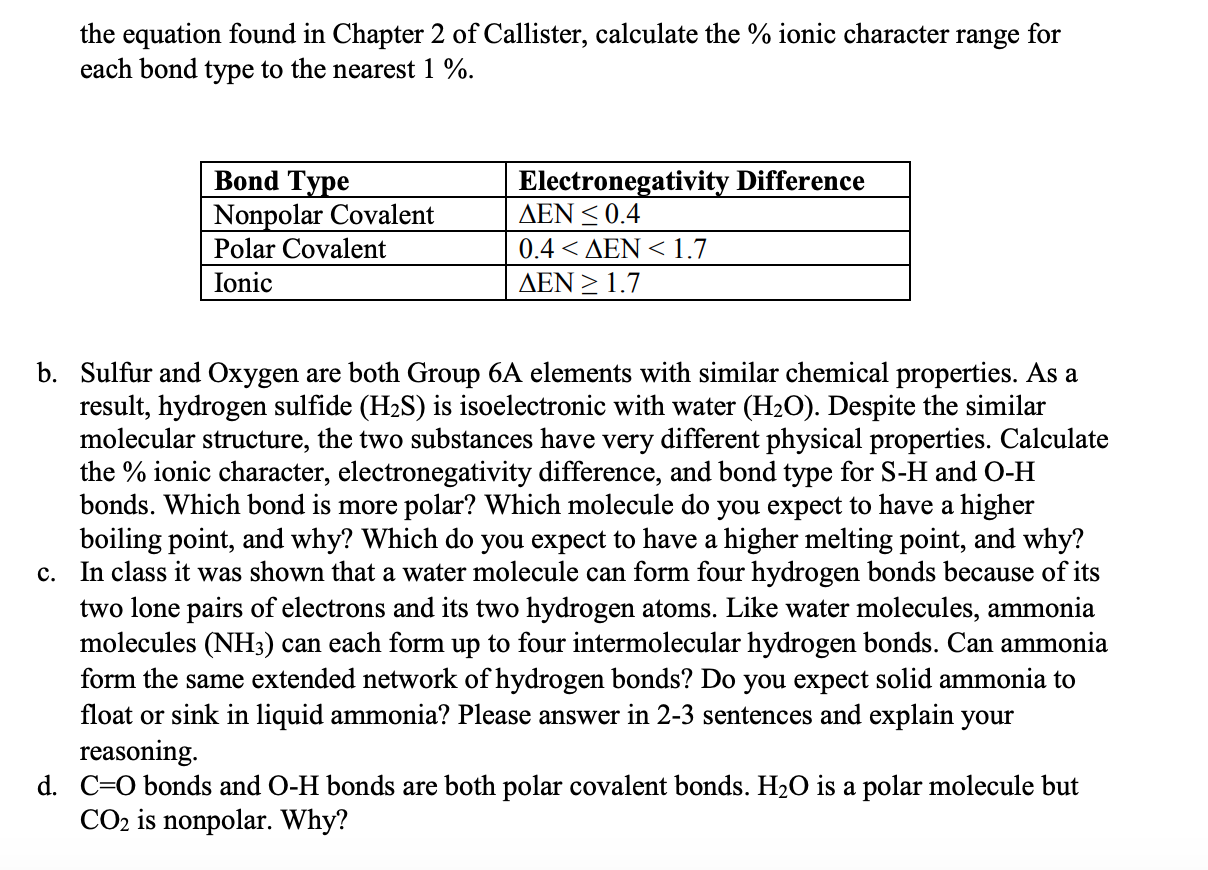
Solved The Larger The Electronegativity Difference En Chegg Com

Electronegativity And Polarity Ppt Download


0 Comments